Technology
E-ink’s quiet second life, away from the e-reader
The same low-power screens that made digital books tolerable in sunlight are turning up on bus stops, warehouse shelves, and hospital badges. The appeal is not novelty. It is a battery that lasts and a display that does not shout.
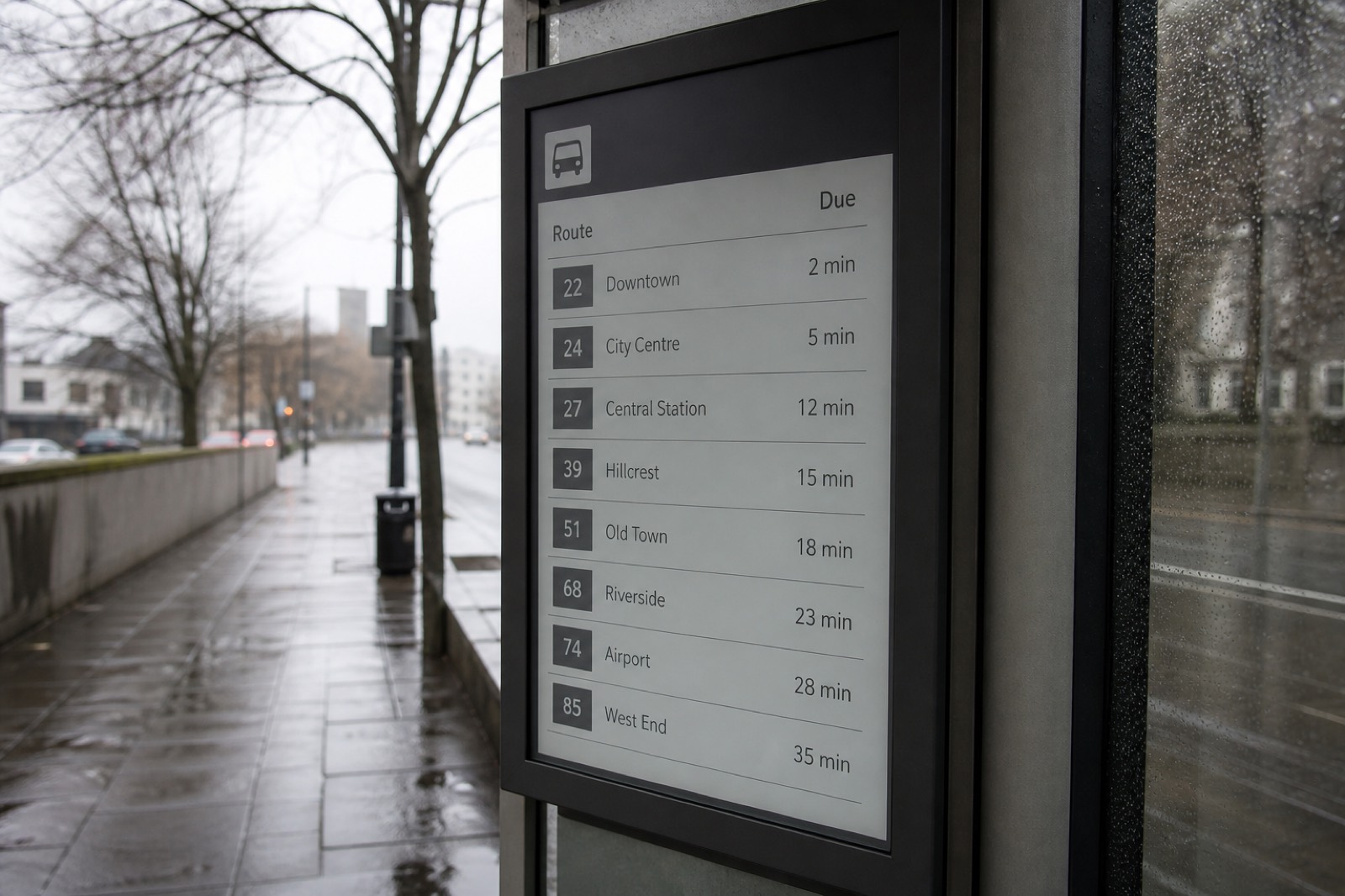
E-ink spent years as a niche inside another niche: the dedicated reading tablet. The technology was easy to dismiss as a compromise, a grey substitute for paper while everyone else chased brighter colour and faster refresh. That story is incomplete. The same properties that made a novel readable on a beach — high contrast in daylight, almost no power use while the image is static — are useful anywhere a screen must be left on and left alone.
Transit agencies noticed first. A paper timetable is out of date the moment a driver calls in sick. A backlit LCD timetable is a glare in the afternoon and a maintenance contract. A matte electrophoretic panel can sit in a shelter, sip a battery or a small solar cell, and change twice an hour. When it fails, it fails into a still image rather than a black rectangle. For a bus stop, that is a kind of grace.
Where the screen does not need to move
Warehouses and retail back rooms are a less romantic market and a larger one. Electronic shelf labels — small e-ink tags that update a price without a paper swap — spread because labour is expensive and mislabelling is worse. Hospitals have tried badge-sized versions for staff names and role colours, cutting the laminate printer and the lag between a rotation and a readable ID. The pattern is the same: information that changes slowly, must remain legible, and should not demand a daily charge.
Colour e-ink has improved enough for maps and simple graphics. It is still slower than the panel in a phone, and it looks washed-out next to OLED. That comparison misses the job. Nobody needs a bus map to play video. They need it not to be invisible at noon.
Why consumers see less of it
Phone makers have little incentive to put a second, duller screen on a device already built around attention. A few experiments with e-ink backs and “focus” phones exist; they remain oddities. Laptops with e-ink lids for calendars have appeared and mostly gone. The consumer electronics cycle rewards spectacle. E-ink is anti-spectacle. Its commercial life is healthier in procurement departments than in launch events.
There is a modest exception in note-taking tablets aimed at people who want a paper-like surface without a stack of notebooks. Those devices succeed or fail on software — file handling, lag, the quality of the stylus — more than on the romance of the screen. Reviewers who treat them as iPad substitutes are asking the wrong question. They are closer to a legal pad that syncs, with all the limitations that implies.
The environmental argument, carefully made
A display that uses power mainly when the image changes is easier on a battery and, in some deployments, easier on a city’s electricity bill. It does not make the device immortal. The electronics behind the panel still fail. Glue still ages. A “paper-like” screen is not paper; it is a stack of chemistry with a shipping weight. The cleaner claim is narrower: for signage that would otherwise be a lit box running all night, e-ink is a better match of technology to task.
That matching is the interesting part of the story. For twenty years the industry assumed every surface wanted to become a bright, scrolling rectangle. A subset of surfaces never did. They wanted to be read, updated, and ignored. E-ink is finally being used for those surfaces, which is less a revolution than a correction. The e-reader was not a dead end. It was a prototype for all the other pages that should never have been backlit in the first place.